Friday, 21 September 2012

Reviews, September 2012


Red Hot Chili Peppers – ‘Magpies on Fire’, ‘Victorian Machinery’, ‘Strange Man’ and ‘Long Progression’

avatarBy , published on 12 September 2012 03:57 pm
Fresh off the back of their 2011 album I’m With YouRed Hot Chili Peppers have now announced a string of singles in quick succession, beginning with this pair of double A-sides. The main problem that arises is how to perceive these 18 new tracks – collectively as an album, or one by one as they arrive? Their purpose is equally confused: should they be seen as a bridge to the next album, or (more likely) tunes that didn’t make the cut forI’m With You? Or, indeed, simply an attempt to continue milking the cash cow of a band who are less and less relevant on the grand musical scale? It’s hard not to be cynical when faced with such a move, until you remember that the Chili Peppers used to spend up to five years preparing new releases, mainly as a result of frequent conflicts withing the group. With this new development, perhaps fans could dare to hope for a more prolific band in future.
In any case, they present us here with four tight, neatly-written but ultimately unexciting songs. ‘Victorian Machinery’ begins with a promising clanking percussion line giving way to churning guitar in the kind of time signature that would make the best of drummers feel faint. Yet all too soon it drops into the mellow, jangling guitar-and-vocals sound that have typified pretty much every song on their last three releases. ‘Strange Man’ is more atmospheric but basically reverses the pattern, with a poppier verse followed by a soft chorus. ‘Long Progression’ contains a number of well-structured vocal harmonies but really could be any other song written by the foursome in the past 13 years. ‘Magpies on Fire’, then, stands out from the crowd as the most coherent and soulful tune, with new recruit Josh Klinghoffer‘s chiming guitar sound blending with Michael ‘Flea’ Balzary‘s crawling bassline, almost making up for the departure of John Frusciante. All in all, these are four nice enough tracks, but that’s the problem – at their prime, Red Hot Chili Peppers were, quite simply, the best, combining one of the all-time great rhythm sections with passionate songwriting and hyperactive inventiveness. Sure, they’ve done a lot of growing up since the early 1990s, but at the same time their sound has lost the sense of fun that defined them as a group.
So while these new releases certainly aren’t bad songs, they’re not all that special either; borne of undeniable musical talent but lacking in any real excitement. They carry the band’s trademark sound but do not make any forward progress with it, instead falling back on what has gone before.  It’s a painfully obvious pun to make, but the Red Hot Chili Peppers have definitely lost some of their heat.
6/10

@TimGreenwood2


Slipknot – Antennas to Hell

avatarBy , published on 18 August 2012 09:47 am
For a band of nameless, faceless Iowans sporting nightmarish masks straight out of a horror film,Slipknot have experienced a surprising level of mainstream success over the course of their career. Notorious for their brutal sound and manic live performances, the group have courted with their fair share of controversy, with lyrics being linked to a fatal school shooting in 2003, to a grave robbing in 2006, and then again to a murder in South Africa in 2008. For their part, the band maintained that their music carried a favourable message, a beacon of hope for disillusioned, isolated youths in the uncaring and unsupporting western world. Antennas to Hell compiles the best of that music, and throughout the progression of its 19 tracks, it is hard to see the positivity supposedly inherent in the music or lyrics. What does become evident, however, is just how revolutionary the group have been over the past decade.
Antennas to Hell encapsulates the evolution of Slipknot – beginning with a collection of sparse, frantic thrash numbers from their self-titled debut, progressing through more coherent metal, and concluding with the songs that made them famous. ‘Duality’, ‘Vermillion’, ‘Psychosocial’ and ‘Before I Forget’ are all present and correct, a string of chart hits that sealed the band’s position among the greats of modern metal. More interesting, however, are the earlier tracks. From the opening ‘(sic)’ to a live recording of ‘The Heretic Anthem’, these tunes provide a voracious bedrock of sound; channelling all the rage and pain that made Slipknot so accessible to millions of moody, repressed teenagers in small-town America. Listening to the desperate howls of vocalist Corey Taylor and the furious drumming of Joey Jordison mixing with Jim Roots‘ twisted guitar riffs, it becomes startlingly clear why a whole generation decided to tap into that sound as a release from the real-world problems that hounded them. It’s tight, it’s fast and it’s fierce: contention over the lyrics aside, Slipknot were an unarguably talented band and while their influence can be heard all over the modern metal scene, it is true that no one else sounds quite like them. Easy listening it isn’t, but that was never the point.
If you are new to Slipknot, or 21st-century metal in general, this greatest hits album is the place to start. If you are a long-time fan of the group, the special edition is worth considering for a live recording of their 2009 Download Festival performance and DVD containing their music video back catalogue.
8/10


Album Review: Noisettes - Contact

17th September 2012 12:08:39


3/5
It has been three years since the Noisettes stuck gold with hit single Don't Upset the Rhythm. They return with new album, Contact, minus a member and attempting to build on their success with a wider musical palette and the same sense of adventure that has maintained them thus far.
The Noisettes are a classic example of the 'I liked them before they sold out for fame' band. It doesn't seem to be widely known, but their debut came not in 2009 but rather in 2007 with the garage punk album What's the Time Mr. Wolf? It was a magnificent first effort, filled with frantic, thrashing rock tunes and the feral howling of singer Shingai Shoniwa standing out in particular. And no one paid it much attention.
Undeterred, the group attempted a foray into the mainstream two years on and it worked -Don't Upset the Rhythm was so far removed from their earlier work that it sounded like a different band entirely. But the new formula was a success: the single reached number two in the UK chart and the subsequent album Wild Young Hearts itself entered the top 10. Ultimately, though, it felt as though the trio had simply dumbed down their original sounds in favour of something more radio-friendly: Wild Young Hearts was not a particularly strong album.
Their latest release, however, is somewhat better. Having dropped drummer Jamie Morrisson, they are no longer really a band, but rather a songwriting duo who rely more on orchestral arrangements and backing musicians than their own individual skills. This is no bad thing - Contact kicks off with a introduction straight out of a film score before segueing into the '70s disco stomp of I Want You Back, which contains an undeniably catchy, singalong chorus.
From there, we are presented with a veritable collage of sounds, stretching beyond the realm of pop music, seemingly into as many genres as the pair can conceive. This happens often within the same song: Travelling Light begins as a piano ballad and ends with a soft dubstep beat, while Let the Music Play is glittering pop with a motown interlude.
Yet for all their experimentation, the Noisettes sound at their best when being truly coherent. That Girl is a genuinely well-written song that would not have sounded out of place in the 1950s, and the folksy Ragtop Car is perhaps the album's prettiest moment. Which presents a paradox: most of the album's appeal is in its experimental side, but this is in conflict with the duo's attempts to craft smooth, well-rounded pieces of music. The result is unfortunate - too many of the tracks descend into repetitve, mid-tempo disco beats, and it feels as though the work has run its course before its conclusion.
While there are indeed positives here - Shoniwa's voice, in particular, has lost none of its flair - Contact feels like a missed opportunity. If the Noisettes could only ignore mainstream expectations, they have the potential to create some of the most original music of recent times. As it stands, they have offered up a competent but uninspiring work that in the end is a victim of its own self-consciousness.


Album Review: Dan le Sac - Space Between the Words

17th August 2012 12:05:44


4/5
Space Between the Words is not a cheerful album. From the opening bars of the terse Long Night of Life, as folk singer Merz calls out "life gets tired of living/devoid of light," it is clear that the Essex-based producer is aiming somewhere between the bleak sound of '80s indie and dingy urban electronica.
And to his credit, the mix is just about right. The beats grind away in the background but never quite overpower the sparse, ethereal instrumentation. The largely obscure guest vocalists, including Sarah Williams White, Joshua Idehen and Pete Hefferan, each add their own style to their respective tracks, leading to a vague narrative structure as they reappear at various points.
Musically, Space Between the Words is more accessible than Dan le Sac's previous work, his abrasive keyboard bleeps of former albums replaced by a more fluid sound in the mould of liquid dubstep. Think Magnetic Man, only slightly more introverted.
This, then, is not a dance album for the clubs, but rather one that is intended to be appreciated on a more cerebral level, to be played in full without interruption or distraction and preferably on a well-specced sound system. It's grimy, intense music - not catchy in the slightest, and not at all ashamed of it. For those who enjoy the album, this will its main appeal - it does not fall back on what has gone before, but rather moves on, drawing on its influences and then updating and expanding them.
Highlights include the minimalist Breathing Underwater, an electro-folk dirge featuring Fraser Rowan and a surging string arrangement; Good Time Gang War, a B.Dolan grime collaboration that threatens a dubstep drop but instead teases the listener with lurching house beats; and the glorious closer Cherubs, the standout track on the album, perfectly pitched between late Radiohead and Morrissey's sombre ballads.
Ultimately, while Space Between the Words may lack the brilliantly poetic and philosophical lyrics of Dan le Sac's work with Scroobius Pip, it does make up for this with a subtler musical approach and more polished production values. It's unlikely to be the soundtrack to your summer, but instead will endure as a slick, brooding work of modern electronica.


Thursday, 13 September 2012

Life in Das Vaterland

After 10 years of foreign language study, the time has come for me to live the dream - to put my skills to their best possible use and head off to a faraway, exotic land free from the rain, traffic, moaning, rain, economic crisis and rain of the UK. With that in mind, I seem to have landed in a place closer to my front door than Scotland, and with almost identical weather patterns and industry. Even the names match - from Bedford to Bedburg. Oh, and I'll be teaching English. No matter, the fact is I'm now in Germany and ready to make the most of
a) actually earning money in exchange for not having to study for a while 
and
b) making the most of 9 months on the continent, seeing new places, meeting new people and experiencing all that the Federal Republic has to offer!

The trip began at the end of August as I departed from Stansted with my dad to look for a place to live in Cologne, a Rhine city that, despite huge residential areas, offered up nothing. Next stop was Bergheim to pursue an internet offer that also came to nothing. Faced with this adversity, I determinedly gave up looking and emailed the teacher who would be in charge of me to ask if there was anything going in Bedburg. Luckily there was, so on September 1st I headed to Bedburg to see the school's presentation day and meet the family whose loft I would be inhabiting for at least a while.

From there it was onward to Altenberg, the former monastery that hosted a training week for all language assistants in Nordrhein-Westfalen, Niedersachen, Bremen and the Saarland. It presented a chance to get to know the fellow students who would be in my proximity for the next year, so predictably the 20 or so of us from Warwick all stuck together from the beginning.

That said, the course itself was surprisingly enjoyable, providing us with a basis in how to lead a class, what German students could expect from us and giving advice in how to survive out here. On the 3rd day we gave a sample lesson on extreme sports and I was told that despite my tendency to fiddle with a pen while talking, I managed well. Aside from that I sampled various varieties of German beer (at €1.50 a pint, how could I not?), inhaled enough 2nd-hand smoke that I would probably have been better off smoking, put in a reasonable juggling performance in the last-night talent show, and exchanged cultural ideas with a group of Canadians on how "Canadian football is like, totally better than American football, eh?!"


Fig. 1: one of the sports.


Fig. 2: the other one.

Altenberg was fun, then, but all too soon it was time to face reality and head to the school where I would be working. And so, on a grey Thursday morning, on the back of 5 hours' sleep and no shower, I was greeted at Bedburg station by Frau Bielert and thrown straight into a meeting with the headmaster. It was here that German efficiency came into play, as he processed the mountains of paperwork concerning me in a matter of minutes, before sending me to the Anmeldeamt to register as a citizen and then Sparkasse bank to set up an account. 

The next day I was in again at 7.50 AM to experience a working day at the school, sitting in on lessons in German, Religious Studies and History, where the origin of World War I was taught with the kind of neutrality I would expect from a country that is never afraid to acknowledge their past.

But this wasn't really why I was here, so on Tuesday I got my first taste of Oberstufe English, the highest level in German schools. No problem, I told myself, an introduction followed by some conversation work and oh dear God they're doing Shakespeare. In English. Not at all modernised or watered down. So, it seems the A-level in English Lit-Lang will have to be brought into play over the coming weeks as rather than correcting grammar or pronunciation mistakes I will instead have to explain the difference between a metaphor and an analogy to an 18-year-old German whose technical knowledge of English is probably better than my own.

Not to worry though, because it has been for the most part fun. I'd honestly forgotten the atmosphere of a sixth-form classroom, a place where for the first time people come together as a group who actually care about what they're learning, and where teachers stop being disciplinarians and start coming into their own. It's a sense of anticipation, of excitement for what lies ahead. Listening to this lot enthusiastically acting out Romeo and Juliet, I was reminded of myself as a fresh-faced languages student halfway through Year 12, the moment when I realised that carrying it on to university might actually work for me. And work it has - thanks to the fact I chose to learn languages, I have, in two weeks abroad, begun my international football career alongside a group of teachers, spent two hours eating piles of food off a barbecue on a Saturday afternoon, agreed to become a gym buddy once my salary turns up and eaten bratwurst with potatoes and sauerkraut, and it was actually pretty good.

The food of kings.


All in all, it makes for an impressively long blog post. And this is only the beginning...


TJGreenwood.

Tuesday, 5 June 2012

5 Bands That Were Just Too Talented For Their Own Good

Everyone has time for a talented musician. It's the reason classical music is still a global industry, the reason an old, formerly homeless man became huge, and the reason why, 35 years after his death, people still consider Elvis to be one of the all-time greats. But with great power comes great responsibility, and sometimes artists can let their talent get ahead of them. Here are 5 bands that were too good for their own good:

5. The Who

The Who were comprised of four of the greatest musicians of their time. Keith Moon remains the most mentalistic drummer ever to set foot onstage; often imitated, never bettered. Pete Townsend was an absurdly acrobatic guitarist, leaping around while windmilling his arms furiously to create his own unique, crashing, chordal style. John Entwhistle was every inch the professional bassist, underpinning the chaos with calm and focus. And in front of it all was one of the all-time great frontmen, Roger Daltrey. With so much to offer, surely they couldn't go wrong?

Why It Didn't Work

OK, so The Who did end up being one of the biggest bands on the planet. But for all their musical prowess and showmanship, it was always clear that they weren't the strongest songwriters out there. All too often when playing live, the group simply descended into trying to outdo each other in terms of who could play the fastest or loudest. Their most famous song, My Generation, for all its raging adolescent subversion, is ultimately just two chords with a bass solo slapped in the middle and the same goes for Magic Bus, I Can See For Miles and Won't Get Fooled Again, three of their biggest hits. Watch this live James Brown cover - complex it isn't:


4. Led Zeppelin


Led Zeppelin were everything The Who were, only stepped up a level. For a start, this was not a group of childhood friends who had shared a joint love of music from the beginning. The four components of the band actually assembled from all over the country, drawn together by the fact that they were already established among the best in their field. Jimmy Page was the young guitar genius from The Yardbirds, John-Paul Jones was a session bassist, John Bonham a freelance drummer with the power of an iron foundry. Robert Plant is just as famous a frontman as Daltrey, with the distinction that he was a uniquely talented singer.

Why It Didn't Work

The Who may have been average songwriters, but once again Led Zeppelin were one step ahead - they didn't bother writing songs at all. Of the 9 tracks on their self titled debut, 3 are covers of Willie Nelson blues tunes. Which would be fine, were it not for the fact that the band claimed the songs as their own, listing themselves as writers and subsequently taking all royalties. This trend continued for another three albums before they finally came up with an original idea. But these songs are simple 12-bar blues pieces, right? No one can copyright those, they're a staple of music; and after all, Led Zeppelin's versions are pretty different to the originals. True, but that doesn't account for the various other songs they outright stole from contemporaries and tried to list as their own creations. It's frustrating more than anything else, especially since, once they stopped resting on their laurels, they wrote some of the best rock songs of all time:


3. Oysterhead


Formed in 2000, Oysterhead were the archetypal constructed supergroup. Bassist Les Claypool had recently disbanded Primus, alternative heroes of the '90s, and agreed on a new project following prompting from his record label. He picked out guitarist Trey Anastasio from psychedelic jam-band Phish and Stewart Copeland, the drummer from The Police. The trio agreed to a one-off show before recording an album, 2001's The Grand Pecking Order. Such a fusion of skill has never really been seen in music before or since - Claypool ranks among the best bassists of all time, Anastasio has a seemingly infinite prowess for improvisation across a range of genres, and Copeland had years of experience as a member of one of the most technically precise groups in music history. And unlike The Who or Led Zeppelin, the band did contain proven songwriters.

Why It Didn't Work

Claypool kind of dropped the ball here. The Grand Pecking Order was actually a fantastic album and, while it wasn't the most accessible music out there, the band gained a devoted following among fans of alternative music, and toured the US in 2001. But Claypool can be something of a lone wolf at times - after all, he quit Metallica in the 1980s because he felt they weren't allowing him enough creative freedom - and the same applied here. As a bassist, he has been the central figure of each of his projects, with the other musicians complementing him rather than the other way around. But Oysterhead was the first time his bandmates matched his talent, and that wasn't the ideal working environment for Claypool. The tragic reality was that Claypool is only satisfied when pushing his boundaries to the limit, and Oysterhead never really provided that. It's clear how unhappy he is in this live performance, and that pretty much sealed Oysterhead's fate:


2. Tool


Tool would at first glance seem to be the most coherent act on this list. They seem to get on well with each other, they've been honing their skills for over 20 years now, and their music just takes everything that has come before to the next level. Blending some of the most technically perfect western alternative rock with the scale structures and cyclical systems of oriental music, the band really do sound like no one else. The level of precision with which guitarist Adam Jones and bassist Justin Chancellor match each other's playing is genuinely mind-blowing - it's as if their minds are telepathically linked. With all this on offer, how can there possibly be anything wrong with Tool's music?

Why It Didn't Work

When a band goes up to six years between album releases, it's clear that they are going to have a lot of time on their hands. But that's true of the Red Hot Chili Peppers as well, and they come nowhere near to ridiculous level of detail employed by Tool in their latest releases. A simple one to start off with: the 11 tracks on their 2006 album 10,000 Days are arranged in clear groups - singles, existentialist meditation, a tale of alien abduction and a eulogy to singer Maynard Keenan's recently deceased mother (who had been paralyzed for 20 years, or approximately 10,000 days). This is all very well, but at the end comes four minutes of electronic noise entitled Viginti Tres. It doesn't work on its own but when combined with the 11-minute 10,000 Days, it matches up with the drone bass of that track. Add in the other eulogy song, Wings for Marie, and the result is a whole new track. The latter two songs synchronise perfectly at 9 minutes and 14 seconds. 9 plus 14? 23, or in Latin, Viginti Tres. This is just one example of how ridiculously obsessed Tool have become with including cryptic messages in their albums - indeed, the whole Lateralus album is in itself a puzzle, with the title track holding the solution. If only they would put that much effort into their music it would be even better than this:


1. Unexpect


Quebec's Unexpect are probably, in a musical sense, the most talented band of all time. Their instrumental co-ordination makes Tool look like amateurs, combining jagged metal rhythms with bizarre time signatures, classical organ motifs and clips of circus music. It's frantic, it's intense, it's all just too... much. What's a shame is that Unexpect are capable of producing beautiful music that stands quite well on its own. Take the piano solo Chromatic Chimera from the EP WE, Invaders:


That's a nice piece of music, right? But when the band re-recorded it as an album track for In a Flesh Aquarium, they just couldn't resist making it more complex:


There's a reason why the bands on this list are also ranked in order of worldwide fame. When you listen to music, you don't want to have to engage in stimulating thought all the time. Had Unexpect stuck with two chords and a bass solo, they could well be topping the charts right now. Sometimes, less is more.

TJGreenwood.

Sunday, 3 June 2012

The 10 Most Inspired Cover Versions of All Time

The concept of cover versions is nothing new in the music world - even Elvis adapted a number of his biggest hits from previously recorded works by lesser-known artists. And yet every so often, an artist produces a cover that completely surpasses the original, either musically or thematically. Here are the 10 best, chosen not purely on merit, but rather due to their originality in reworking already great songs:

10. William Shatner - Lucy in the Sky with Diamonds.

Originally by: The Beatles.

Star Trek fan or otherwise, it's hard to dislike the surreal precision with which William Shatner delivers the lyrics to some of the greatest songs ever written. As a result, his version of Lucy in the Sky with Diamonds comes across as far more bizarre and spaced out than The Beatles could ever make it sound. Try to watch the video without at least smiling - it just goes to show how absurd the pseudo-mystical poeticism of the original really was.


9. Imelda May - Tainted Love

Originally by: Soft Cell.

Imelda May sounds something like Amy Winehouse on steroids - all the soul and accomplished vocals, but played at a furious rockabilly tempo. Her cover of Soft Cell's '80s goth-pop classic transforms it from a depressing break-up tune to the war-cry of a devilish femme fatale, who couldn't care less about the man she has just left - she's simply moving onto her next kill.


8. Earth, Wind and Fire: Got to Get You Into My Life.

Originally by: The Beatles.

This funktastic effort by the spectacularly flamboyant Earth, Wind and Fire probably takes home the prize for the best ever Beatles cover. It picks up on the bouncy rhythm and catchy melody of the original and takes the tune to a stratospheric level, turning what was once a well-written pop song into a spectacular soul rendition. Although Paul McCartney deserves a lot of the credit for having produced such an inherently infectious song in the first place.


7. Evelyn Evelyn: Love Will Tear Us Apart.

Originally by: Joy Division. 

 A bit of background is necessary for this one - Evelyn Evelyn are supposedly a duo consisting of conjoined twins, singing and playing a variety of cabaret pieces in harmony. In reality, of course, they aren't - for a start, the two musicians are different genders. It does mean, however, that the song becomes a truly dark piece of humour, since if either of the twins falls in love, they will literally have to tear themselves apart. Also, it is undeniably a truly heartfelt performance of what is already a bleak eulogy for lost love.


6. Rammstein: Stripped.

Originally by: Depeche Mode.

This is a classic example of a song being rendered completely unrecognisable from its original form. Depeche Mode's slightly creepy ballad of desire becomes, in the hands of East Germany's teutonic metal lunatics, a crushing criticism on media control and post-communist confusion in their homeland, Till Lindermann's Wagnerian vocals taking it to operatic proportions. The video digs up another era of Germany's past, sampling Leni Riefentstahl's film of the 1936 Berlin Olympics.


5. The White Stripes: Death Letter.

Originally by: Son House.

It's debatable whether this actually counts as a cover, as the majority of Son House's work is now considered standard blues canon, but The White Stripes undeniably make this Depression-era tale of death and isolation their own. When performed live, Jack White showcases his slide playing at its best, battering the life of what is essentially an acoustic guitar and producing more sound than any one person should rightfully be able to. It's not a lament, it's a display of defiant anger directed at the cruelty of life.


4. Leon Russell: A Hard Rain's Gonna Fall.

Originally by: Bob Dylan.

Bob Dylan is unquestionably one of the greatest songwriters of the 20th Century, if not the very best. But when performing as a solo artist, he failed to match this with musical ability. As a result, much of his early work is pretty hard listening, with turgid guitar rhythms countered only by Dylan's often flat vocals. Enter Leon Russell: rock's archetypal southern gentleman may look like Gandalf, but he injects a much-needed boost into A Hard Rain's Gonna Fall, transforming it from a dirge into a righteous, soulful anthem on imminent nuclear warfare.


3. The Red Hot Chili Peppers: Higher Ground.

Originally by: Stevie Wonder.

There is little that hasn't already been said about both of the artists involved here. Stevie Wonder's plea for reason was in itself a technically impressive piece of music, showcasing his ear for electronic manipulation as well as complex rhythmic structures. The Chili Peppers had a solid enough foundation to work on, then, but certainly made the piece their own, from Flea's jaw-dropping introductory bassline to the en-masse chorus vocals to the furious thrash ending. Much like the above entry, it's a protest song given the kick it deserves thanks to the creative input of a musically superior artist.


2. Rodrigo y Garbiela: Stairway to Heaven.


Originally by: Led Zeppelin.

This cover is impressive not only on a musical basis, but also due to the fact that it's of one of the songs that literally every guitarist in the world can play. The virtuoso Mexican duo make it their own by starting out with a kind of classical cadenza, before moving onto free jazz and finishing off with aggressive rock. It's an entirely original reworking of a tune that has been done to death - and the fact that it has avoided coming under fire from Led Zeppelin fans (traditionally some of the most humourless people on the internet) is testament to its universal appeal.


1. Faith No More: Easy.

Originally by: Lionel Richie.

Mike Patton has covered a frankly ludicrous range of songs in his various incarnations, most of which have been performed only once, during live shows. It's generally agreed this habit was borne of a narcissistic desire to prove his ability to sing anything, which would be pretty objectionable were it not for the fact that he actually does have that ability. Easy was recorded as a single by Faith No More in 1993, during the period when they were beginning to leave the trail of being just another alternative rock group. What makes it brilliant is that it's not all that different to the original, and yet it's different enough that what was once a nicely-written easy listening tune becomes a world-weary declaration of resignation. Patton's voice soars effortlessly above the piano line, and by the time the guitar solo kicks in, the listener is left in no doubt that they have done the song justice. When covering a song called Easy, it makes sense that to do it well, you shouldn't be trying too hard.


TJGreenwood.

Album Review: Tenacious D, "Rize of the Fenix"

Published 3/6/12 on spiltinc.co.uk


It has certainly been a while since Tenacious D offered up anything new for our listening pleasure, and no one knows it better than the band themselves. Indeed, Rize of the Fenix was preceded by a YouTube release of an introductory video in which the duo recounted their activities since their ill-advised film project The Pick of Destiny flopped at the box office. Jack Black was shown living a life of Hollywood excess, while Kyle Gass locked himself in his basement constructing an elaborate plan of bitter revenge on his former bandmate. At the video’s conclusion the pair were reunited and vowed to record another album, rising, as it were, like the phoenix from the ashes.
Rize of the Fenix, then, is a comeback album about making a comeback album. From the opening title track, which urges fans to renew their (previously removed) band tattoos, to ‘The Ballad of Hollywood Jack and the Rage Cage’, which recounts events since their 2006 separation, the album remains wittily self-referential throughout. This includes the two spoken-word interludes ‘Classical Teacher’ – in which a world-famous classical guitarist is employed to get Kyle’s playing back into shape and things quickly turn weird – and ‘Flutes and Trombones’, dealing with a studio dispute over the band’s instrumentation. Elsewhere, the duo engage in blunt innuendo (‘Low Hangin’ Fruit’), a spaghetti western tale (‘Senorita’) and even end with a moderately serious ballad on the nature of growing old (’39′).
Of course, the album would be nothing without considerable musical talent to supplement the tomfoolery, and of course the pair offer this up in spades, especially since they have convinced Dave Grohl to return once more on drums. It has taken its time to arrive, butRize of the Fenix is a triumphant return for Tenacious D.
9/10.

Sunday, 13 May 2012

6 Songs That Made Good Films Great

Nothing can be as affecting in the cinema as a well-chosen song. I don't mean music that has been written specifically for the film, or songs that play over the credits, or musical numbers that are fully integrated into the plot. Instead, this about songs that already existed in their own right, but which directors chose to supplement their images, making these films much better than they would have been without:

6. All Saints: Pure Shores.

The Film: The Beach (Danny Boyle, 2000).

Based (not particularly well) on Alex Garland's cult novel of the same name, The Beach features a young Leonardo DiCaprio as the hero Richard, who journeys to a secluded commune on a beach in Thailand with a pair of French backpackers. Once there, his feelings for the female traveller (Virginie Ledoyen) develop to the point where they can no longer maintain their pretences and dive into the sea to make passionate love to the sounds of... a British girl band? Indeed, but All Saints were no Spice Girls: they were musically and lyrically self-sufficient, and Pure Shores is actually the perfect song to accompany the film's blossoming romance. Languid, summery and upbeat, it marks the point where the film stops trying to cram the plot of the novel into as short a space of time as possible and instead becomes a portrait of the idyllic environment of the beach, a place as yet unspoiled by the tourist trail. The underwater scene is a classic example of Boyle's eye-poppingly colourful visual aesthetic, meaning this scene alone pretty much makes the entire film worthwhile:


5. Gary Jules: Mad World.

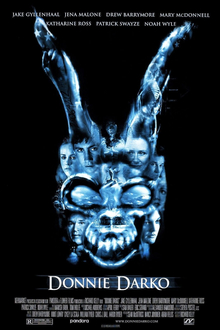
The Film: Donnie Darko (Richard Kelly, 2001).

Arguably a masterpiece even without this song, Donnie Darko is without question one of the most complex and confusing films ever made, right up to the concluding scene where (spoiler alert) a falling jet engine is sent back in time by the hero to crush him to death in his bed and thus prevent any of it from ever having happened in the first place. What makes that last scene so special, however, is undoubtedly Gary Jules' cover of the Tears for Fears song Mad World. As the truth about the film's characters is revealed in the moments leading up to Donnie's death is revealed, the song adds its own level of emotion to the plot, asking the question of whether the small-town concerns of any of the characters are really worth anything when viewed in the context of the "end of the world" that has been foreshadowed throughout the film. Either way, no one can deny that it all adds up to a poetically beautiful piece of cinema:


4. Stealers Wheel: Stuck in the Middle With You.

The Film: Reservoir Dogs (Quentin Tarantino, 1992).

The story of a failed bank robbery, sliced and diced into an almost incomprehensible order in trademark Tarantino fashion, Reservoir Dogs is actually fairly understated in comparison to the director's later works. There is, however, one brutal, iconic scene that stands out from the rest. Having captured a policeman and brought him back to his gang's warehouse, Michael Madsen's Mr. Blonde ties him to a chair and, with the sounds of Stealers Wheel's one-hit-wonder Bob Dylan spoof Stuck in the Middle With You echoing on a radio in the background, proceeds to cut his captive's ear off. Setting such a gory concept to inane musical backing is something that makes Tarantino unique as a director, and this scene stands out in Reservoir Dogs as the one that has been referenced and parodied countless times in other works. Yet at the same time the song's lyrics reflect the criminals' predicament: they are literally stuck in the middle of a city filled with police, with no way out. Be warned: while we are spared seeing the actual cutting itself, this is still pretty grim:


3. M.I.A.: Paper Planes.

The Film: Slumdog Millionaire, (Danny Boyle, 2008).

The second Danny Boyle film on this list, proving the director has a distinct sense for finding the right songs to complement his filmmaking. Slumdog Millionaire follows Jamal as he attempts to win a fortune on India's version of Who Wants to be a Millionaire, where, by a staggering coincidence, all of the questions match up to episodes in his life. A slightly improbable premise, but one with ultimately rewarding results, as it would take a heart of stone to resist the feelgood factor of the closing scenes. Sri Lankan/British hip-hop artist M.I.A. provides the soundtrack for one of the film's most affecting scenes as the young Jamal and his friend Salim try to make a living on the railways, the ever-changing background providing a glimpse of the majestic variety that makes up the subcontinent. The song is at once western and eastern, traditional and modern, the ideal complement to a film dealing with the rapid modernisation of the Third World as much as the adventures of its protagonist:


2. Mr. Loco: Religious Man.

The Film: Nacho Libre (Jared Hess, 2006).

Nacho Libre is the best film ever made about a Catholic monk who secretly dreams of leaving his life of piety to become a professional wrestler, and all other opinions are false. A large part of its appeal lies in the entertaining and charming soundtrack, mostly by US alternative hero Beck but also with contributions from Mexican artists. Religious Man was written by 1970s Mexican band Mr Loco, and features during the film's opening credits and penultimate scene as Jack Black - playing a Mexican version of his usual character - finally claims victory in the ring and saves the day for the orphanage where he used to work. It's a predictable ending, and one that would seem very tired were it not for the honest brilliance of this song: it is genuinely uplifting, and yet modest enough that the scene as a whole doesn't become overblown. Anyone who does not feel stirred when watching is a soulless automaton completely devoid of human emotion. Sadly neither scene seems to be available on the legal part of the internet, so here's the song on its own:


1. Elton John: Pinball Wizard.

The Film: Tommy (Ken Russel, 1975).

I know I said I wasn't going to allow musical numbers, but just watch: it's Elton John playing a pinball machine piano alongside The Who in a concert hall while wearing enormous shoes. It's a superlative example of postmodernist musical filmmaking, an explosion of sound and colour made at a time when the average television set was still black and white. It's one of The Who's better songs made great by an artist who many people now forget was actually a supremely talented musician. It seems incredible that the entirety of western culture didn't simply give up after having witnessed it. At the end of the day, it's the definitive example of how one song can raise the level of an entire film simply by its inclusion, and few others can match it.


TJGreenwood.