Saturday, 13 May 2017

9 - Make Something Up

I would think the vast majority of people are only familiar with the works of the Seattle writer Chuck Palahniuk through the film adaptation of his first novel, Fight Club. And still more who do count themselves as fans will have been introduced to him by that film.

My path was slightly different - when reading an article about the most famous bodies of water in literature (must have been a slow news day), I learned of Palahniuk's short story Guts, a tale supposedly so shocking it caused people to faint at live readings. I was intrigued, but ultimately forgot about it. And then I saw Fight Club.

In fairness, the film's success is well deserved, and it is thanks in no small part to Palahniuk's writing which transposes perfectly to the interior monologue of Edward Norton's narrator, itself broken down into convenient soundbites to spawn a million anti-consumerist tweets sent from a million iPhones. Not long after I decided to hunt down Guts and read it as part of the short story anthology mashed together into a meandering novel titled Haunted. I didn't pass out, but Guts certainly hit home, a shocking tale of the depravity and subversion simmering literally just below the surface of American suburbia. The other stories were somewhat inconsistent but there were still a few gems - most notably Obsolete and Foot Work, both of which deserve big-screen adaptations of their own.

Make Something Up is Palahniuk's second collection of short stories, and ultimately the same appraisal can be made. While it drops the overall plot that weaved in and out of Haunted, there are still a few subtle connections between the 24 pieces that form the whole. This is most obvious in a triptych of stories featuring anthropomorphised animals loosely resembling Aesop's fables but with moral conclusions so brutally mean-spirited they leave a sour aftertaste. Similar in nature are the likes of Cannibal, Zombies and Tunnel of Love, three tales in keeping with the general theme of the grim reality of American society. These are hardly enjoyable reading and ultimately I failed to see the point, unless there was no point other than to show that, a lot of the time, life is arbitrary and unfair.

Equally hard to get on with were the more experimental stories. The dense word-fog of Smoke and the endless malapropisms shoved into Eleanor result in prose that is borderline unreadable, and while they undoubtedly took a lot skill to write, there is not much enjoyment to be gleaned. It's akin to listening to a world-class musician practicing scales for hours on end. Slightly more successful was Liturgy, an exercise in the art of the euphemism of upper-middle class society.

But as with Haunted, there are more than a few stories here that just work. Essentially a shaggy dog story told in stream of consciousness style, The Facts of Life is perhaps the most shocking of the bunch, but also the funniest in my opinion. Torcher cleverly doubles up as a murder mystery caper and a savage satire of the trust fund hippie culture; Expedition mixes Kafka and de Sade into a foreshadowing of a possible Fight Club sequel. And call me soft, but while Fetch and Mister Elegant may seem incongruous with their happy endings, they stand out as the two most enjoyable stories here.

Objectively the best, however, would have to be Inclinations. Being the longest story in the book, it has room to develop its characters, lurch from ironic to funny to terrifying to foul and back again, and deliver plenty of twists along the way. Again, while I am perhaps not quite tuned into its portrayal of the unique pressures and intricacies of American life, it does deliver a sensitive look at the teenage experience that is not often seen in literature.

Overall, I found the quality of these stories to vary immensely. While all were shocking in their own way, it is what Palahniuk actually does with that shock value that means at least a few of them go above and beyond that basic level. One thing is for sure - the collection's subtitle, Stories You Can't Unread is more than suitable.

2.5/5

Undoubtedly, this is a pretty punk form of writing, but that's another area I'm not particularly attuned to. In the end, while I'm sure there are plenty more out there, the best act I could think of to blend punk aesthetic with a certain level of technical ability is Pixies. Oh, and their song Where is my Mind plays over the closing credits of Fight Club, so that'll do.


Monday, 17 April 2017

8 - Les Stiene de la Castafiore

I must have been around 8 when I first became a fan of Tintin. Within a couple of years, I had managed to read every one of Hergé's albums featuring the character - or rather, the 21 of the original 24 that are freely available in English - thanks to a local library. The adventures of the young reporter provided an ideal combination of fun and excitement, not to mention the brilliant scope of Hergé's artwork. Although how Tintin managed to keep his job while doing so little actual reporting will remain a mystery.

As my interest in languages grew, I began to collect Tintin albums in French and German as easy reading for practice, which allowed me to cross Tintin in the Congo off my list - a book widely restricted in the English-speaking world due to its broadly racist portrayal of Africans. And since I was on a beginner's Dutch course for the last six months, my parents thought it would be a good idea to add to my collection with a new title in Dutch. There was just one problem - the book I received was actually in Bruxellois.

Bruxellois, as you might expect, is the language spoken by the residents of Brussels; however, as stated in the explanatory notes at the back of the book, the term actually covers five distinct slang dialects. Principal among these are French, Flemish and mixed Bruxellois - the latter providing the basis for this Tintin translation. The Brabantian-based Marollien dialect and Bargoentsh are much more obscure, and barely spoken today.

Unfortunately for my Dutch development, Bruxellois is grounded mainly in French, with the occasional interjection of Dutch, plus some Spanish and a few words with no obvious background. Still, I would probably have struggled with French alone - words such as 'astableeft' ('alstubleeft') meaning 'please' and 'band' in the context of 'tyre' are, to my knowledge exclusive to Dutch. Mainly, though, Bruxellois is used for the character's exclamatory interjections - Tintin's English catchphrase 'great snakes!' becomes 'potverdèkke!' while the creative cursing of Captain Haddock is rendered as an impenetrable lists of nouns and adjectives with no obvious basis in anything.

Ultimately I found myself skimming over the dialect words because the intended meaning was nearly always clear. The translator's note clarifies that Bruxellois is nowhere near a complete language, being limited to only a couple of hundred words used to embellish conversation with irony and self-deprecation, and as such I thought it was actually a very good fit for the dynamic dialogue of the characters and in particular the captain. While a glossary is provided I referred to it increasingly little as the book went on, preferring to follow the plot at its intended pace.

As for the book itself - well, it falls firmly in the middle of the late-era Tintin albums. Not as grand in its scope as Tintin in Tibet or The Calculus Affair, but mercifully lacking the half-baked weirdness of Flight 714 to Sydney and Tintin and the Picaros, it is the opinion of the majority of Tintin academics (yes, that's a real thing) that this would have been a suitable end to the series. I have to agree: the majority of the recurring characters play a role and still more are referred to in passing, a sort of final reunion. The opera singer Castafiore and her entourage seem finally to be moving on to bigger things, and the Thompson twins leave as they first arrived, in a state of chaos. As the work concludes, Tintin, Snowy, Haddock and Calculus seem ready to retire in the peaceful surroundings of Marlinspike Hall, their adventures at an end.

The plot is a meandering detective story, revolving around the disappearance of Castafiore's jewels and Tintin's attempts to solve the mystery. It unravels in a farcical manner as time and again Tintin follows a clue to a dead end, before finally coming good in working out the twist ending. The only work to be set entirely at the characters' "base camp" of Marlinspike Hall, it showcases Hergé's talent for humour in dialogue, and ability to tell a story without relying on adventure to exotic settings. No coincidence that it was written at the time in his life immediately following a period of depression due to his divorce.

5/5

Reading this was undoubtedly a rather hipster undertaking. So here's some Belgian hipster music which is also actually good:


Saturday, 15 April 2017

7 - A Brief History of Time

Around two and a half years ago, I went to the cinema to watch The Theory of Everything, James Marsh's biopic detailing the life and career of Stephen Hawking. It left me inspired to learn more about the scientist's research into physics and cosmology, and I decided the place to start would be to read his hugely popular and successful book for the layman, A Brief History of Time. Fortunately my parents already had a copy, so I borrowed it and then proceeded not to read it. But now I felt it might be a good time to break up all the science fiction on my list with some science fact.

A Brief History of Time was published in 1988 and collates all of the existing theories surrounding the relationship between time and space and the connection of forces within the universe that had been developed up to that point. Hawking then discusses the possible directions this research could take, with the overarching theme of whether mankind will ever be able to comprehend the nature of the universe.

I suspect that, if such an answer is ever found, I will not be the one to do it. Hawking states in his introduction that he had been advised to include as few equations as possible; that for each one that appeared in print, the readership of his book would halve. The problem that results from this is that he must then describe a number of highly abstract concepts by way of roundabout explanation - and often I found that words were probably not the best way of going about it. The use of diagrams helps in some cases, but I actually found myself wishing that he had simply used an equation and then elaborated upon it to aid visualisation.

Too often, Hawking describes a concept using an analogy only to refer to it in passing later on under the assumption that the reader has absorbed and understood all that it entails. While this might be possible with more serious study of each idea, that wasn't the book's intended purpose and the result is that, towards the end, nearly every sentence becomes a dense fog of technical terminology that does more to create confusion than to clarify.

But I suspect a lot of this will relate more to me as an arts student than anyone with a more in-depth knowledge of maths and physics. While the ideas he describes can be dense and abstract at times, Hawking's writing style as a whole is largely the opposite - as you would expect from a scientist he is methodical and precise in his work. I found the chapter on elementary particles to be quite engaging, and in fairness he does stress that a lot of the theories discussed are, by definition, theoretical. I am not sure what advances have been made in cosmology since 1988 but at the time there seemed to be a general lack of concrete evidence for pretty much everything. Otherwise he does manage to slip the occasional joke in, the anecdotes about the lives of scientists of the past are fun, and the underlying philosophical discussion of the nature of our existence, the possibility of God as creator and which direction the human race will take next is one that any reader should ponder.

Almost 30 years on from this book's publication, I am not sure we are any closer to finding the Grand Unified Theory that Hawking suggests could provide all the answers - but if we do, it will be in no small part due to his work. Just not necessarily this book.

3/5

Remember this?


Sunday, 2 April 2017

6 - Stories of Your Life and Others

It will become clear over the course of this year that I am a fan of science fiction. So it was with some regret that I did not make it as far as seeing Denis Villeneuve's much-praised Arrival when it was in cinemas at the end of last year. I could, however, read the story on which it was based.

Stories of Your Life and Others brings together the short(ish) stories that make up the first half of the career of American author Ted Chiang. While there are elements of science fiction in the stories, they could perhaps best be described as speculative science fact. In short, Chiang asks the question "what would happen if..." and then sets up a world in which that is reality. At the same time, he manages to establish a cast of characters and begin, develop and conclude their story arcs. This is an achievement in itself given that most of the stories are under 50 pages. But it's really only half of the whole.

Chiang is clearly a very intelligent man. While Wikipedia states that his academic endeavours concluded with a bachelor's degree in computer science, I find it hard to believe that he is anything short of PhD level in pretty much every discipline. In fact, the story Understand follows the path of a man who is endowed with a superhuman intelligence that allows him to collate and then transcend all existing human thought, and I imagine Chiang's mind to be on the same plane.

The collection starts in a relatively straightforward manner with Tower of Babylon, an account of the biblical tale of a tower constructed with the aim of reaching God. Once you can get past the physical differences to our world, the story builds nicely to a surprising conclusion and you find yourself immersed in the setting. But that's about as easy as it gets.

It's probably no coincidence that I found Story of Your Life, the inspiration for Arrival, to be the next-most accessible story. During my MA course I was forced to attend a module on research methodologies in applied linguistics. Perhaps it was due to the fact that the lectures were held at 9am on Monday mornings, but I found it hard to see any significant application beyond that study of the vocabulary sizes of various rappers and the recent article breaking down Donald Trump's speech patterns. But Story of Your Life provides another possible use - when aliens first make contact with Earth, a linguistics researcher is sent in with the seemingly impossible task of deciphering what the aliens are saying, and then replying to them. The zen-like approach to language that Chiang invents for the aliens is truly inventive, as is the way in which the story develops and then concludes once the main character begins to understand how to speak and read it herself. It's an abstract story in a lot of ways, but I felt that my knowledge of the area helped keep me grounded.

Consequently, I think there was probably a lot I didn't catch in the other stories. GCSEs in maths and biology only got me so far with Division by Zero and Seventy-Two Letters, while my knowledge of theology (Hell is the Absence of God), sociology (Liking What You See: A Documentary) and genetics (The Evolution of Human Science) is even less developed. And as stated above, to fully understand Understand would require multiple lifetimes of study in a multitude of subject areas. Which is actually the point of the story.

But none of this matters too much, because Chiang can write. While in less capable hands these stories might be frustrating, falling into either textbook-like descriptions of the worlds they describe or focusing too much on the characters and leaving the setting underdeveloped, Chiang balances the two perfectly, meaning that while the concepts require a lot of additional thought, the stories themselves are surprisingly easy reading.

4.5/5 for making me feel stupid.

If The Life & Death of Scenery was the 2nd-best sci-fi hip hop album of 2016, then clipping.'s Splendour and Misery was the best. Producers Jonathan Snipes and William Hutson work on a high level of theory - the latter may have completed a PhD in experimental music, but the concise and entertaining flow of rapper Daveed Diggs means you don't need one yourself to enjoy it.


Sunday, 19 March 2017

5 - Anthem

As I was passing through my edgy modernist phase during the course of my A-levels, for some reason Ayn Rand was never an author that was particularly on my radar. I'm not sure why this was - the English course itself provided me with a pretty extensive reading list in terms of dystopian fiction, from the obvious (1984, Brave New World, A Clockwork Orange) to the slightly less so (Kazuo Ishiguro's Never Let Me Go, Margaret Atwood's visceral The Handmaid's Tale). Nor was my personal reading limited - I ran the gauntlet from Knut Hamsun's Hunger to Don DeLillo's White Noise, both unsettling books in their own right from opposite ends of the 20th Century. Yet the works of Rand, despite being considered parallel to all of these, remained unread.

But I was not unaware of her existence, so decided now was the time to give one of her books a try. The two generally cited as her best, Atlas Shrugged  and The Fountainhead, are not particularly conducive to a year of reading more than one book, so instead I opted for the lesser-known 1938 novella Anthem.

Anthem portrays a future society under supreme control - citizens devoid of all individualism to the point where the narrator refers to himself exclusively in the third person, and each character is assigned a number rather than a name. Technology and cultural activities are also strictly limited, and it is alluded that both of these played a part in the destruction of the society that preceded the current one. The whole is presided over by a council of elites; the similarities with the Soviet Union are clear, although the extent to which that is true borders on prescient considering the date of writing.

Our hero, the snappily named Equality-2521, stands alone as an individual seeking to escape from this system. Having been identified as a potential troublemaker at an early age, he is consigned to a life of sweeping the streets of his city. But this cannot crush his spirit, as he studies science in secret and dreams of escaping from the city with a peasant girl he has seen working in the fields.

Political connotations aside, Anthem is a brilliantly written book. While 1984 portrays a truly viable vision of a future police state but is hampered by Orwell's appallingly ham-fisted prose style, and Brave New World is well written but has dated somewhat, Anthem suffers from neither of those issues, and it must be borne in mind that it is from broadly the same period as both. Rand's writing is perfectly concise, revealing just enough about the world of her novella for the reader to understand the context, but still building up to the reveal of the mystery at the end.

The ending is certainly the main source of contention. While the "forbidden word" that has been hinted at up to this point is somewhat predictable, it still serves as a relevant reminder of the dangers of a society where individualism is suppressed to too great an extent. However, the new direction followed by Equality-2521 and the girl, Liberty 5-3000 - living at one with nature outside society - seems somewhat trite, and really isn't a million miles from the Völkisch ideology that the Nazis were pushing in Germany at the time. It's easy to see why Rand's works are so beloved by the libertarian right, but in the case of Anthem I think they've actually missed the point. As the novella concludes, there are hints that the new, rather isolationist, commune built by Equality-2521 will eventually head down the same route that led to the self-destruction of the society of the "Unmentionable Times". A cycle in which there is no real winner, perpetuated by the tendency of human nature to scramble to extremes in both directions. Sobering stuff.

5/5

Pretty much everything is banned in Anthem; L'Orange and Mr. Lif's The Life and Death of Scenery imagines a world in which that extends merely to all forms of culture. It was probably the second best sci-fi rap album of 2016.


Sunday, 12 March 2017

4 - Catch-22

"They're not going to send a crazy man out to be killed are they?"

"Who else will go?"

The above quote is perhaps the most succinct representation of the titular, much misused, catch that permeates Joseph Heller's Catch-22. Barely a paragraph goes by in which the characters are not confronted with another form of the famous logical paradox. The perfect contradiction of it comes to define practically every character's story arc, their interactions, their conversations and their very existence. All of this and more is why I have come to consider it my favourite book.

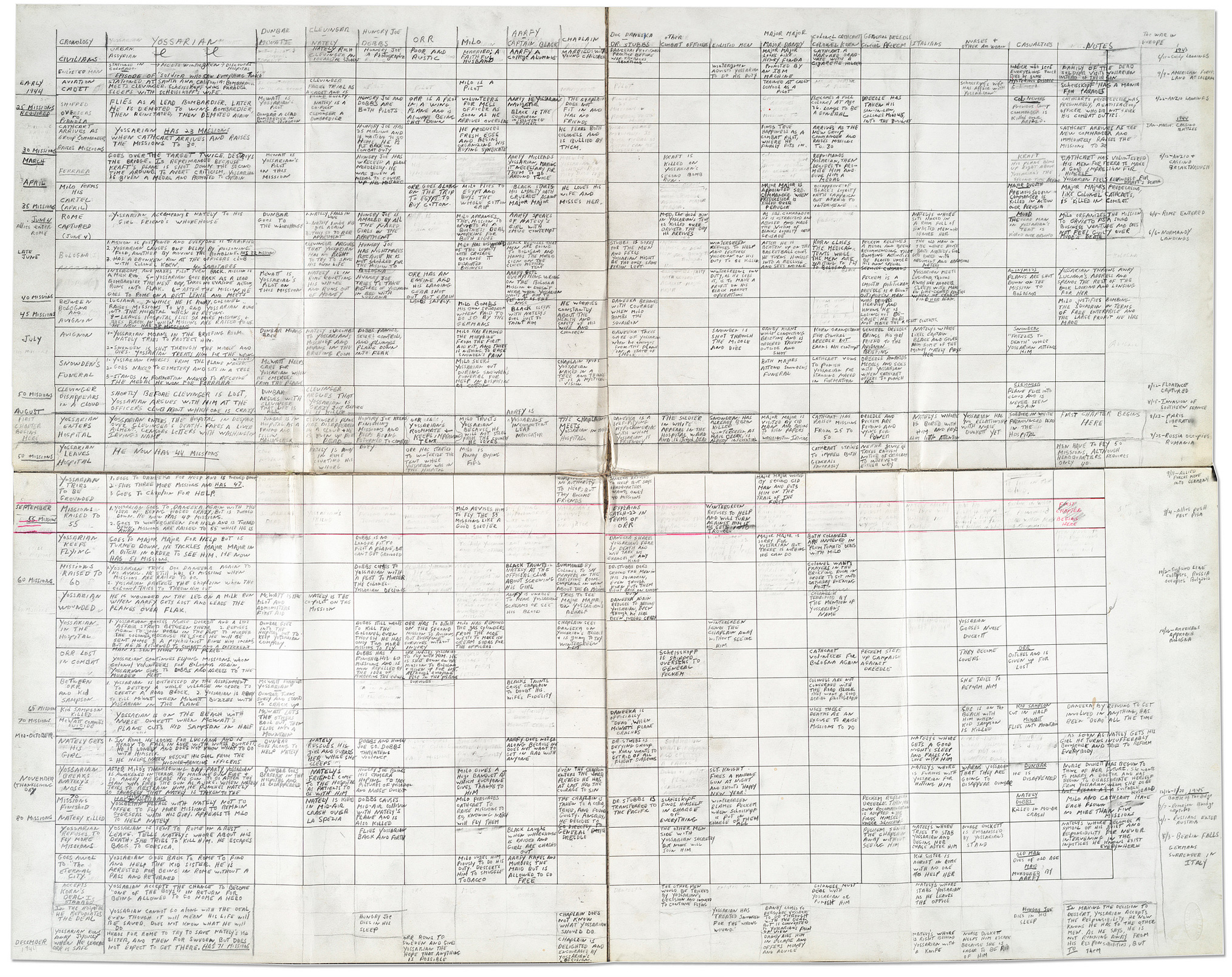
However, the novel's first line - "It was love at first sight" - doesn't quite reflect my relationship with it. On the first reading, the plot is so brutally complex and non-linear that it isn't until beyond the halfway point that the reader can begin to piece together what actually happens, and when. Indeed, to attempt to explain it here would require more words than the book itself, so here's a drawing by Heller himself:


Much better.

In fact, this was my fourth time taking this particular ride, and I was surprised at how much of the plot was just second nature to me. This allowed me to appreciate the little allusions and connections throughout the book that link the episodic chapters to one another, ensuring it is so much more than just a collection of short stories.

And yet the chapters, especially the longer among them, serve perfectly well as stories on their own. The story of Milo Minderbinder and his preemptive forays into the post-war globalist world of trading, in particular, would work brilliantly as a film, as would perhaps the earliest moments in the work's timeline in which Yossarian is subjected to the absurdity of basic training, the ever present threat of actual combat hanging over him and concluding in the incident that drives his perspective for most of the book.

Countless words have already been written about the catch-22 concept and its logical and philosophical connotations; about Heller's (decidedly negative) portrayal of war and his use thereof as an analogy for the wider world; about the criticisms that are levelled at the contemporary society of the 1960s under this guise. Still more have been written about the use of language in the book, how it reflects the catch scenario in itself, and how the threads of narrative weave together to form a cohesive whole. I doubt that I will be able to add much to any of this, other than that these are all parts of what make it such a masterpiece in my opinion.

Instead, what struck me most this time around was the work's sensitivity. Hiding among all the absurdity of the dialogue are some outstanding soliloquies on the intransigence of life and the inevitability of death. The scene where Yossarian is made to pose as an airman already killed in battle in order to provide closure to his family who have come to visit him on his deathbed stood out as particularly poignant, but there are several similar moments where the action slows down a touch to provide similar hubris. A number of characters become, even with all the madness that surrounds them and which they seem to willingly perpetuate, tragic figures at the mercy of forces beyond their control.

The final quarter of the narrative in particular becomes almost relentlessly pessimistic, until the final scene which brings together all the hints and allusions at a possible solution that have been building up to that point. It wraps up the book as a whole in a way that is - and I don't use this word lightly - nothing short of genius.

This a book that everyone should read, and then read again. I for one anticipate getting through it many more times in my life, and I genuinely expect to take away something new each time.

5/5, obviously.

It seems fitting that my favourite book should go hand in hand with my (current) favourite song - Outkast's Southernplayalisticadillacmuzik. The album by the same name actually has a few things in common with Catch-22, namely the way in which threads of themes mesh together throughout to form a whole that is greater than the sum of its parts, but at the same time those parts somehow work better on their own. In itself that's a catch-22 scenario...


Sunday, 5 March 2017

3 - Bricking It

I mentioned in my introductory post that I used a commute into London for a previous job to get some serious reading done. One, slightly less serious, book that I got through during that period was another Kindle recommendation - Nick Spalding's Fat Chance. I picked it up as something lighter, having been assured by reviewers that it was genuinely funny, and found that in spite of myself I had to agree. But there was also a lot more to it than that - I found it a brilliantly frank portrayal of married life, the rapid onset of middle age and all the shortcomings of the diet "industry". There were some great set pieces, each chapter acting almost as a self-contained story, some moving moments, and, as I have already said, I'd be lying if I tried to claim it didn't make me laugh.

Since I hadn't set any intellectual requirements for this year's endeavour, I decided Spalding's newest work might be worth a look. The similarities between the two are obvious - both are told from two, alternating, points of view, both concern the trials of the main characters in their attempts to reach a goal, and both are ultimately quite British in their scope. While Fat Chance chronicled the attempts of a married couple in losing weight for a competition, Bricking It is the story of a brother and sister attempting to rebuild and then sell a house left to them by their grandmother.

There are also similarities between the flaws of both books. Spalding does not have a particular talent for dialogue, and the result is conversations between characters that come across as stilted or just plain unnatural. And the interior monologues are only slightly better. Conversely, while in Fat Chance the main couple were well developed in spite of a rather vaguely portrayed set of minor characters, the opposite is true in Bricking It - the story arc of the siblings is rather predictable, but the supporting cast is full of memorable figures that add colour to the work.

Where Spalding salvages all of this, to the extent that all of these criticisms become secondary, is in his fantastic ability to construct a set piece. With each chapter serving as an episode within the greater context of the plot, he manages to cram an entire story, from start to finish, twenty times over into the novel. It is in this context that the comedy works best - scenes involving a box in the attic and a bonfire with unexpected consequences stood out as particular highlights. But it also ensures that, while the overall plot of the book may be quite simple and linear, the pace of the book remains consistently fast throughout. I doubt there will be many other books this year that I finish quite so quickly.

And, once again, I have to admit that I laughed out loud at times.

4.5/5

If this book were to be adapted into a film, I feel it would be at least 43% montage scenes. At least one of them deserves to be set to this:


Simple and unassuming, yet amusing and clever.